
- HOME
- RESEARCH
- Machine Learning in AAV Research
Machine Learning in AAV Research
Machine Learning in AAV Research
 AI-Driven AAV Vector Engineering
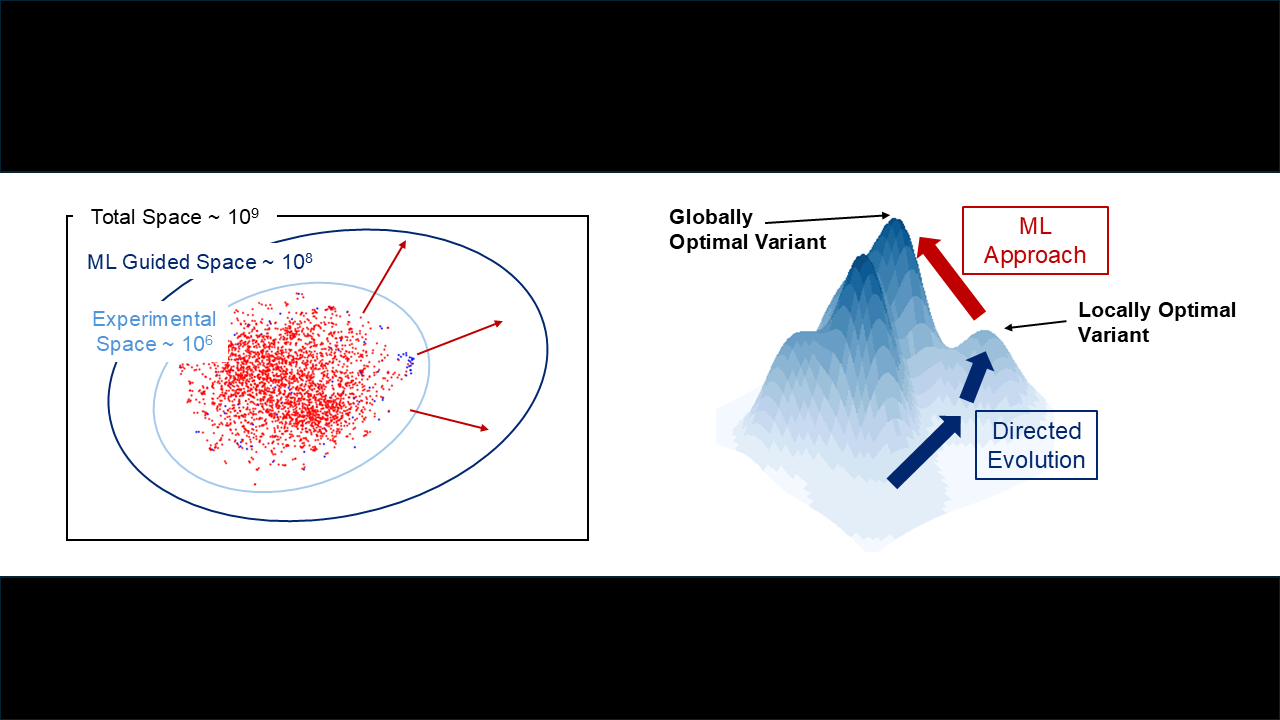
Machine learning (ML) and artificial intelligence (AI) offer robust, data-driven solutions to overcome the inherent limitations of conventional gene therapy development. In the context of in vivo gene delivery, where vector performance is governed by complex and multidimensional biological factors, AI enables faster, more precise, and more cost-effective optimization than experimental iteration alone.
Directed evolution remains a foundational strategy for AAV vector discovery; however, it is intrinsically constrained by limited library diversity, selection bottlenecks, signal loss during screening, and experimental noise. To address these challenges, our laboratory leverages large-scale experimental datasets derived from extensive AAV library construction, screening, and validation studies. These datasets are used to train, benchmark, and refine multiple ML models, enabling the development of custom, high-accuracy predictive frameworks capable of proposing purpose-driven, AI-designed AAV vectors.
We further integrate structure-based AI approaches, including AlphaFold-based modeling and advanced protein–protein docking tools, to predict interactions between AAV capsid loop peptides and cell-surface receptors on target tissues. This strategy facilitates the rational discovery of novel vectors with enhanced tissue accessibility, improved functional performance, reduced off-target transduction, and deeper mechanistic insights into in vivo delivery mechanisms—outcomes that would otherwise require extensive time and experimental resources.
All AI-predicted vectors undergo rigorous experimental validation, establishing a closed-loop AI–experiment cycle that continuously improves predictive accuracy and accelerates the development of customized, ultra-precise AAV vectors for next-generation in vivo gene therapy.
Tel. +82-2-2123-7456 | Fax.+82-2-312-6401
COPYRIGHT© YONSEI UNIV. ALL RIGHTS RESERVED.
